


Inclined Bed CNC Lathe
What Is Inclined Bed CNC Lathe
An inclined bed CNC lathe is a type of machine tool used for turning operations on metal or other materials. Unlike traditional flat bed lathes where the bed is horizontal, an inclined bed lathe has its bed inclined at an angle. This design offers several advantages such as improved chip removal, better visibility of the machining process, and enhanced ergonomics for operators. Inclined bed CNC lathes are commonly used in industries that require precision turning operations on various workpieces.
Advantages of Inclined Bed CNC Lathe
Good stability
Need to process large parts generally use inclined bed CNC lathe guide rail machine tools, because the corresponding parts of medium and large machine tools are also very large, especially the tower parts, the use of inclined guide rail is mainly to overcome gravity to have better stability to improve the accuracy of machine tools, in some harsh environment can reflect the advantages of inclined machine tools.
Improve the utilization rate
The tilting machine tool can effectively utilize the space and greatly reduce the plane area of the machine tool.
Easy to remove chips
The inclined guide rail also facilitates the concentration of iron chips in the chip removal machine for automatic chip removal. The iron chip under the cutting has a high heat, the accumulation in the guide rail will make the guide rail heat deformation, so that the working accuracy changes, in the mass automatic processing process will lead to the mass scrap of the workpiece.
High degree of automation
The increase in the number of machine tools and the configuration of automatic chip conveyors are actually the basis of automated production. One person on duty with multiple machine tools has always been the development direction of machine tools.


Why Choose Us
The Difference Between Inclined Bed CNC Lathe And Flat Bed CNC Lathe
Compare machine layouts
The two guide rails of the flatbed CNC lathe are parallel to the ground plane. The planes of the two guide rails intersect with the plane of the ground to form an inclined plane with angles of 30°, 45°, 60° and 75°. From the side of the machine tool, the flat bed CNC lathe bed is square, and the inclined bed CNC lathe bed is a right triangle. Obviously, under the same guide rail width, the X-direction carriage of the inclined bed is longer than that of the flat bed. The practical significance of applying it to a lathe is that more tool positions can be arranged.
Rigid Cut Contrast
The cross-sectional area of the inclined bed CNC lathe company’ s inclined CNC lathe is larger than that of the flat bed of the same specification, that is, the bending resistance and torsion resistance are stronger. In the direction of the workpiece bevelling, the cutting force of the CNC lathe with inclined bed is basically the same as the direction of the workpiece gravity, the spindle runs relatively smoothly, and it is not easy to cause cutting vibration. When the flat bed CNC lathe is cutting, the cutting force generated by the tool and the workpiece is 90° with the gravity of the workpiece, which is easy to cause vibration.
Comparing machining accuracy
The drive screw of the CNC lathe is a ball screw. The transmission clearance between the lead screw and the nut is small, but it does not mean that there is no clearance. As long as there is a gap, when the lead screw moves in one direction after reverse transmission, the repeated positioning accuracy of the CNC lathe with reverse gap will inevitably occur, thereby affecting the machining accuracy. The layout of the inclined CNC lathe can directly affect the clearance of the X ball screw, and the gravity directly acts on the axial direction of the screw, so that the reverse clearance of the transmission is almost zero. The x-direction lead screw of the flat CNC lathe is not affected by the axial gravity and cannot directly eliminate the clearance. This is the inherent precision advantage brought by the design of the inclined bed CNC lathe.
Compare chip evacuation capabilities
The inclined bed CNC lathe is affected by gravity, so it is not easy to produce winding tools, which is conducive to chip removal; at the same time, it has an intermediate screw and guide rail protection sheet, which can avoid the accumulation of chips on the screw and guide rail. Inclined CNC lathes are generally equipped with automatic chip removal machines, which can automatically remove chips and increase the effective working time of workers. It is difficult to increase the automatic chip conveyor with the flat bed structure.
Automated production comparison
With the increase in the number of machine tools and the configuration of automatic chip conveyors, it is actually laying the foundation for automated production. One person on duty for multiple machine tools has always been the development direction of machine tools. The inclined CNC lathe increases the milling power head, automatically feeds the machine tool or manipulator, automatically feeds, completes all chip processes in one clamping, automatically feeds, and automatically removes chips, making it an efficient fully automatic CNC lathe. The structure of the flat bed CNC lathe is at a disadvantage in automated production.

The inclined bed CNC lathe is a precision CNC lathe with high precision, flexibility and durability, elegant appearance and strong practicability. It is suitable for precision machining of various high-precision, multi-batch, complex-shaped parts used in aviation, electronics, clocks and other industries.
The inclined bed CNC lathe is a 30° inclined guide rail micro machine tool, which is characterized by high precision, fast speed and high spindle speed. It is widely used in the processing of medium-sized parts such as aviation, electronics, glasses, and lighters. Within minus 0.005, the inclined bed CNC lathe adopts hard guide rails, gear shifting, and hydraulic clamping. It is the most advanced medium-sized parts processing machine on the market.
The CNC lathe with inclined bed is suitable for processing rotary parts with complex shapes, and can perform turning of cylindrical, curved, tapered and stepped surfaces. It can not only perform external turning and internal turning, but also turn various internal and external threads, as well as drilling, reaming, reaming and rolling. Main structural features of CNC lathe with inclined bed. Adopt the overall high-strength cast iron bed base, 60° inclined bed, smooth chip removal and good rigidity. Each motion axis adopts linear guide rail, no creep, and high positioning accuracy. Quick-change tool holder, all kinds of tool holders are fully configured, and the efficiency is high.
The New Trend Of Inclined Bed CNC Lathe Design
In people's impression, CNC lathe with inclined bed is a large-scale machine tool with large area and heavy tonnage. Although it is difficult to change this cumbersome image for a while, some companies in the industry have begun to bring forth new ideas in the design of CNC lathes with inclined beds. The bed structure adopts a more lightweight design, which also leads to new trends in machine tool design. In order to carry out the lightweight design of the CNC lathe with inclined bed, it is necessary to clarify what the lightweight indicators are. In layman's terms, it is to reduce the material consumption and energy consumption during the manufacture of the bed under the condition of satisfying the static stiffness of the machine tool itself, and reduce the weight of the bed as much as possible.
So, how can the designers of CNC lathes with inclined bed achieve the goal of lightweight design? First of all, it is necessary to establish a physical model of the bed design, find a better structural optimization path on the basis of this model, and further optimize the design parameters. At the same time, it is necessary to combine the casting process requirements and impose corresponding process constraints. Secondly, the designers have to further optimize the bed size of the CNC lathe with inclined bed. Specifically, the finite element software is used to obtain a series of performance parameters and data, and the corresponding functional relationship is obtained through the performance parameters and data. , and then combine the various characteristics of the bed to obtain the final optimized size of the bed.
After the optimization design of the CNC lathe with inclined bed is completed, it does not mean the end. The designer also needs to analyze and compare the static stiffness and equipment performance before and after the design. Seven or more, and the static stiffness remains unchanged, which shows that the design has achieved the predetermined goal. This trend is inevitable for the development of the industry. If manufacturers can master lightweight design technology, they will be able to develop in the future. become the development of the industry.
1.Fixed point
First of all, it is necessary to determine how many maintenance points a CNC machine tool with inclined bed has, scientifically analyze the equipment, and identify the parts that may fail. As long as these maintenance points are "watched", faults will be found in time.
2.Calibration
For each maintenance point of the boat, it is necessary to formulate standards one by one, such as clearance, temperature, pressure, flow, tightness, etc., there must be clear quantitative standards, as long as the specified standards are not exceeded, it is not a failure.
3.Regularly
How often to check, to set the check cycle. Some points may need to be checked several times in the boat class, and some points may be checked once or once a month, which should be determined according to the specific situation.
4.Fixed items
What items are checked at each maintenance point should also be clearly defined. The boat point may check one item, and may also check the child item.
5.Determine the person
Who conducts the inspection, whether it is the operator, maintenance personnel or technicians, should be implemented according to the inspection site and technical accuracy requirements.
6.Confirmation
There are also regulations on how to check, whether it is manual observation or instrument measurement, and whether to use ordinary instruments or precision instruments.
7.Check
The inspection environment and steps must be specified, whether it is to be inspected during production operation or shut down, and whether to dismantle inspection or not to dismantle inspection.
8.Record
The inspection should be recorded in detail and filled in clearly according to the prescribed format. The inspection data and the difference between the inspection data and the prescribed standard, the judgment impression and the handling opinion should be filled in. The inspector should sign and indicate the inspection time.
9.Processing
If the inspection can be processed and adjusted in the middle, it should be processed and adjusted in time, and the processing results should be recorded in the processing records. Those who do not have the ability or conditions to deal with it should report to the relevant personnel in a timely manner and arrange for treatment. However, anyone and any time processing must fill in the processing record.
10.Analysis
The inspection records and processing records should be systematically analyzed on a regular basis to find out the weak "maintenance points". That is, the points with high failure rate or the links with large losses, put forward opinions and submit them to designers for improvement.
Installation Of Inclined Bed CNC Lathe
The inclined bed CNC lathe is a two-axis linkage semi-closed-loop full-function CNC lathe. The main shaft is a high-rigidity and high-speed structure. It is driven by a servo motor and can realize infinitely variable speed, constant line speed cutting and high-speed cutting. The optional power tool function and ten hydraulic turrets can meet different needs of processing, and are suitable for the processing of various products and small and medium-sized products; it shows its superiority for complex and high-precision parts.
The inclined bed CNC lathe is placed on the foundation, it should be leveled in a free state, and then the adjusting horns are evenly locked. For ordinary machine tools, the level reading does not exceed 0.04/1000mm, and for high-precision CNC machine tools, the level does not exceed 0.02/1000mm. When measuring the installation accuracy, it should be carried out at a constant temperature, and the measuring tool should be used after a period of constant temperature. When installing the inclined bed CNC lathe, try to avoid the installation method that causes the forced deformation of the CNC machine tool. When installing the inclined bed CNC lathe, some parts of the machine should not be removed casually. The disassembly of the parts may lead to important new distribution of the internal stress of the CNC lathe, thus affecting the accuracy of the CNC machine tool.
After the geometric accuracy of the inclined bed CNC lathe has passed the inspection, the whole machine needs to be cleaned. Use cotton or silk cloth soaked with cleaning agent, not cotton or gauze. Clean off the anti-rust oil or anti-rust paint applied to protect the guide rail surface and the processing surface of the inclined bed CNC lathe when it leaves the factory. Clean the dust from the outer surface of the machine tool. Coat each sliding surface and working surface with lubricating oil specified by the machine tool. Carefully check whether all parts of the inclined bed CNC lathe are oiled as required, and whether enough coolant is added to the cooling box. Whether the oil of the hydraulic station of the machine tool and the automatic lubricating device has reached the position specified by the oil level indicator. Check whether the switches and components in the electrical control box are normal, and whether the integrated circuit boards are in place. Power on and start the centralized lubricating device, so that the lubricating parts and lubricating oil passages are filled with lubricating oil,Do all the preparations before the action of each part of the machine tool.
Our Factory
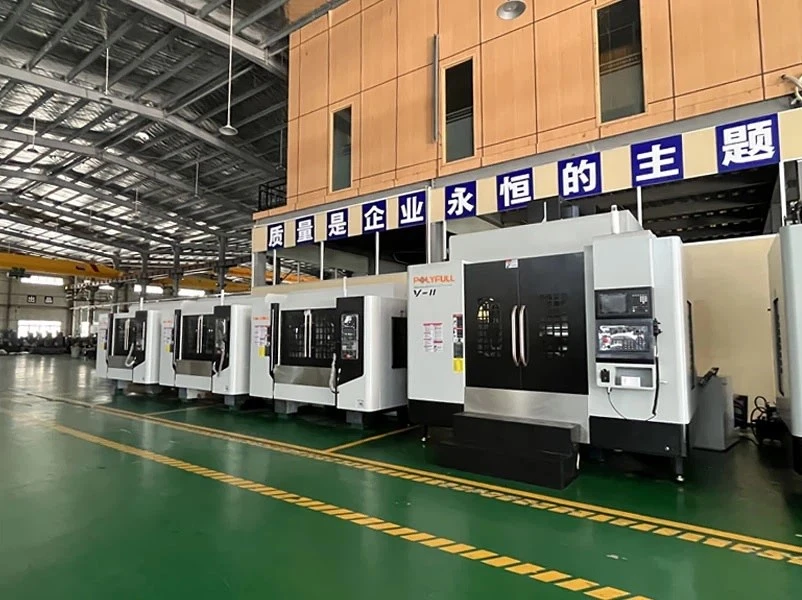
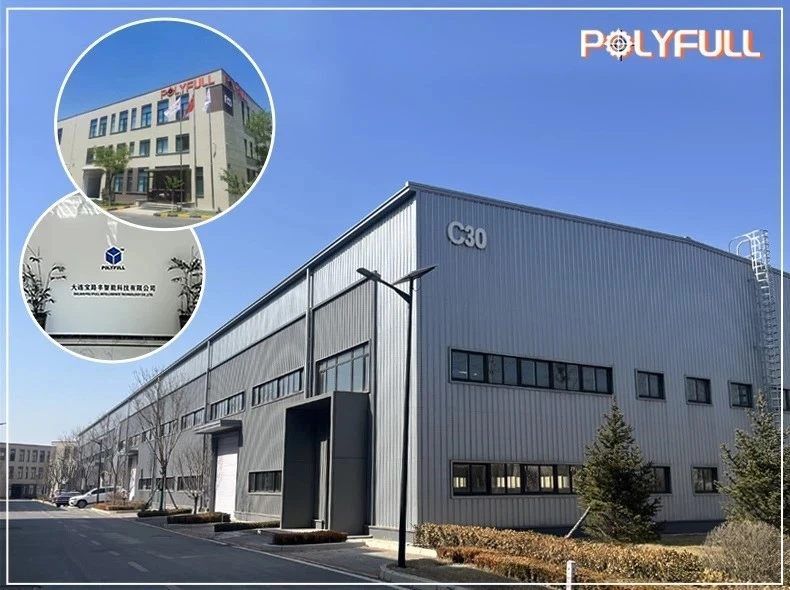
Dalian Polyfull Intelligence Technology Co.,Ltd. is a professional machine tool manufacturing enterprise, the main products include lathe, milling machine, grinding machine, etc., and according to customer needs we also can design and manufacture various special purpose machines, to provide relative technology upgrading and transformation services in machine tool field. Meanwhile we are a company that produces automated robots. We can design,develop, install, test, debug industrial robot, it’s units and related accessories including fixture transmission device, positioning device and control system. We can provide welding robot, slicing robot,painting robot,assemble robot,burnishing robot,handing robot,inspect robot,arc welding robot and so on. We have provided many references for the automation industry in China.
FAQ
We're professional inclined bed CNC lathe manufacturers and suppliers in China. Please feel free to buy high quality inclined bed CNC lathe for sale here and get quotation from our factory. For customized service, contact us now.
rod machining with inclined bed cnc lathe, operator panel for inclined bed cnc lathe, high accuracy inclined bed cnc lathe