

Hey there! As a supplier of detection robots, I often get asked about the communication protocols these nifty machines use. So, I thought I'd sit down and share some insights with you all.
First off, let's understand why communication protocols are so important for detection robots. These robots are designed to perform various tasks, from inspecting industrial equipment to detecting environmental hazards. To do their jobs effectively, they need to be able to send and receive data accurately and efficiently. That's where communication protocols come in.
One of the most common communication protocols used in detection robots is Modbus. Modbus is an open-source protocol that's been around for ages. It's simple, reliable, and widely supported by different types of devices. In a detection robot, Modbus can be used to communicate with sensors, actuators, and other components. For example, a robot might use Modbus to read temperature, pressure, or humidity data from sensors installed in an industrial facility. It can then send this data back to a central control system or operator for analysis.
Another popular protocol is CAN (Controller Area Network). CAN is a serial communication protocol that's known for its high reliability and real-time performance. It's commonly used in automotive and industrial applications, and it's also a great choice for detection robots. CAN allows multiple devices to communicate on the same network, which is useful when a robot has multiple sensors and actuators. For instance, in a robot used for material handling, CAN can be used to coordinate the movement of different parts of the robot, such as the arms and the grippers.
Ethernet/IP is also a significant player in the world of detection robot communication. It's based on the standard Ethernet technology, which means it can take advantage of the high-speed data transfer capabilities of Ethernet networks. Ethernet/IP is often used in large-scale industrial automation systems, where detection robots need to communicate with other machines and systems over long distances. For example, in a factory with multiple production lines, a detection robot using Ethernet/IP can send inspection results to a central database for quality control purposes.
Now, let's talk about some more specialized protocols. For robots that are used in wireless environments, ZigBee can be a good option. ZigBee is a low-power, wireless communication protocol that's designed for short-range applications. It's ideal for detection robots that need to operate in areas where wired connections are not feasible, such as in a large outdoor area or a building with many obstacles. A robot equipped with ZigBee can communicate with other nearby devices, such as sensors placed around a perimeter, to gather data about the environment.
Bluetooth is another well-known wireless protocol that can be used in detection robots. It's widely available on many devices, including smartphones and tablets. This makes it easy for operators to communicate with the robot using a mobile device. For example, an operator can use a Bluetooth-enabled app to control a small inspection robot, like the Inspect Robot, and view the data it collects in real-time.
When it comes to choosing the right communication protocol for a detection robot, there are several factors to consider. The first is the type of application. If the robot is going to be used in a high-speed, real-time environment, a protocol like CAN or Ethernet/IP might be the best choice. On the other hand, if the robot needs to operate wirelessly in a small area, ZigBee or Bluetooth could be more suitable.
The distance between the robot and the other devices it needs to communicate with is also important. For short distances, wireless protocols like ZigBee and Bluetooth are great. But for longer distances, wired protocols or high-power wireless protocols might be necessary.
The number of devices on the network is another factor. If there are many sensors and actuators that need to communicate with the robot, a protocol that supports multiple devices, like Modbus or CAN, would be a good option.
As a detection robot supplier, I've seen firsthand how the right communication protocol can make a big difference in the performance of a robot. For example, we have a line of Polish Robot that uses Ethernet/IP to communicate with the control system. This allows for high-speed data transfer and real-time control, which is essential for the precision polishing tasks these robots perform.

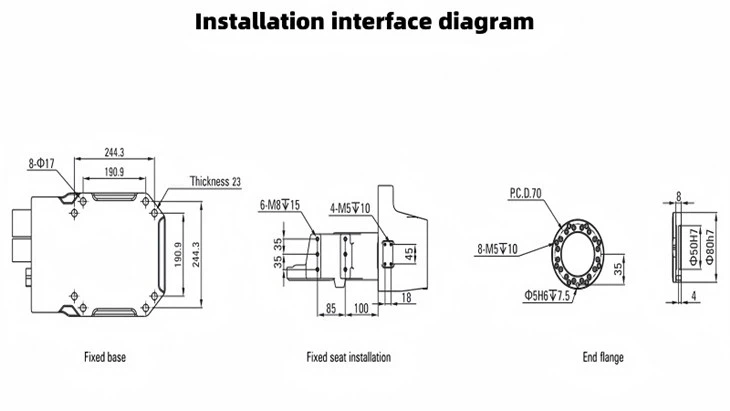
Our Material Handling Robot uses CAN to coordinate the movement of its different parts. This ensures smooth and efficient operation, even when handling heavy loads.
In conclusion, communication protocols are the backbone of detection robots. They enable these machines to communicate with sensors, actuators, and other devices, which is crucial for their proper functioning. Whether it's Modbus for simple and reliable communication, CAN for real-time performance, or a wireless protocol like ZigBee or Bluetooth for flexibility, choosing the right protocol is essential.
If you're in the market for a detection robot or have any questions about the communication protocols they use, I'd love to have a chat. We can discuss your specific needs and find the best solution for you. Don't hesitate to reach out, and let's start a conversation about how our detection robots can benefit your business.
References:
- "Industrial Communication Technology Handbook" by Peter G. Neumann
- "Automation Communication Protocols: A Practical Guide" by Thomas J. Burke