

Hey there! As a supplier of Flat Bed CNC Lathes, I've been getting a lot of questions lately about the chuck types commonly used in these machines. So, I thought I'd put together this blog post to share some insights.
First off, let's talk about what a chuck is. In simple terms, a chuck is a device used to hold the workpiece securely in place on the lathe. It's a crucial component because it ensures that the workpiece stays stable during the machining process, which is essential for getting accurate and high - quality results.
1. Three - Jaw Chuck
One of the most commonly used chucks in Flat Bed CNC Lathes is the three - jaw chuck. This chuck is super popular because of its self - centering feature. When you put a round or hexagonal workpiece into a three - jaw chuck, the jaws move simultaneously to center the workpiece automatically. This saves a ton of time since you don't have to spend ages adjusting the position of the workpiece manually.
The three - jaw chuck works great for round workpieces. If you're machining a cylindrical part, like a shaft or a pipe, the three - jaw chuck will hold it firmly. It's also pretty easy to use. You just place the workpiece in the chuck, and then use a chuck key to tighten the jaws.
However, the three - jaw chuck does have its limitations. It's not the best choice for irregularly shaped workpieces. If your part has an odd shape, the jaws might not be able to grip it evenly, which could lead to problems during machining.
2. Four - Jaw Chuck
Next up is the four - jaw chuck. Unlike the three - jaw chuck, the four - jaw chuck doesn't self - center. Each jaw on a four - jaw chuck can be adjusted independently. This gives you a lot more flexibility when it comes to holding different types of workpieces.
If you're working on a square or rectangular part, the four - jaw chuck is your go - to. You can adjust each jaw to fit the shape of the workpiece precisely. This also means that you can use the four - jaw chuck for off - center machining. For example, if you need to drill a hole that's not in the center of a circular workpiece, you can position the workpiece in the four - jaw chuck to achieve this.
But, the four - jaw chuck does require more skill and time to set up. You have to adjust each jaw carefully to ensure that the workpiece is properly centered and held securely. If you're new to using a four - jaw chuck, it might take a few tries to get the hang of it.
3. Collet Chuck
Collet chucks are another option for Flat Bed CNC Lathes. A collet is a sleeve - like device that grips the workpiece. Collet chucks are known for their high accuracy and concentricity. They can hold the workpiece very precisely, which is great for machining operations that require tight tolerances.
Collet chucks are especially useful for small - diameter workpieces. If you're making small pins or rods, a collet chuck will hold them firmly and accurately. They also have a quick - change feature. You can swap out collets easily to accommodate different workpiece sizes.
On the downside, collet chucks have a limited range of workpiece sizes they can hold. Each collet is designed for a specific size or a small range of sizes. So, if you're working with a wide variety of workpiece diameters, you'll need to have multiple collets on hand.

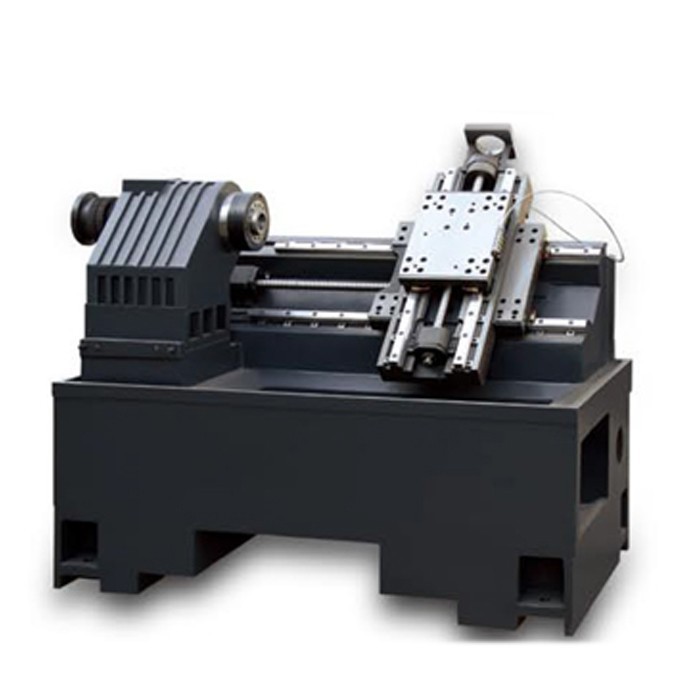
4. Magnetic Chuck
Magnetic chucks are a bit different from the other chucks we've talked about. Instead of using mechanical jaws to hold the workpiece, they use magnetic force. These chucks are great for holding ferromagnetic materials, like steel.
The advantage of a magnetic chuck is that it provides a large contact area between the workpiece and the chuck. This means that the workpiece is held very securely, and there's less chance of it moving during machining. Magnetic chucks also allow for easy loading and unloading of the workpiece. You just turn on the magnetic field to hold the workpiece in place, and turn it off to remove it.
However, magnetic chucks are only suitable for ferromagnetic materials. If you're working with non - magnetic materials like aluminum or plastic, a magnetic chuck won't work.
Choosing the Right Chuck for Your Flat Bed CNC Lathe
Now that you know about the different types of chucks, how do you choose the right one for your Flat Bed CNC Lathe? Well, it depends on a few factors.
First, think about the type of workpieces you'll be machining. If you're mostly working with round parts, a three - jaw chuck might be the best choice. If you need to work on irregular or off - center parts, a four - jaw chuck could be more suitable. For small - diameter, high - precision work, a collet chuck is a great option. And if you're dealing with ferromagnetic materials, a magnetic chuck might be the way to go.
Another factor to consider is the level of accuracy you need. If your machining operations require tight tolerances, a collet chuck or a four - jaw chuck adjusted carefully might be necessary.
At our company, we offer a range of Flat Bed CNC Lathes, including Flat Bed Linear Guide Way CNC Lathe, Hard Rail Flat Bed CNC Lathe, and Linear Rail Flat Bed CNC Lathe. We can also help you choose the right chuck for your specific needs.
If you're in the market for a Flat Bed CNC Lathe or need advice on chuck selection, don't hesitate to reach out. We're here to help you make the best decision for your machining operations. Whether you're a small - scale workshop or a large manufacturing plant, we've got the solutions you need.
References
- "CNC Machining Handbook"
- "Lathe Operations and Tooling Guide"